Relay AI helps teams automate repetitive work across the systems they already use.
Executive readout: Is product usage becoming repeatable and economically sustainable?
Workflow volume is up 42%, but repeat use is concentrated in a small group of accounts.
Signal
Most accounts try Relay, but do not build a repeat usage habit.
Evidence
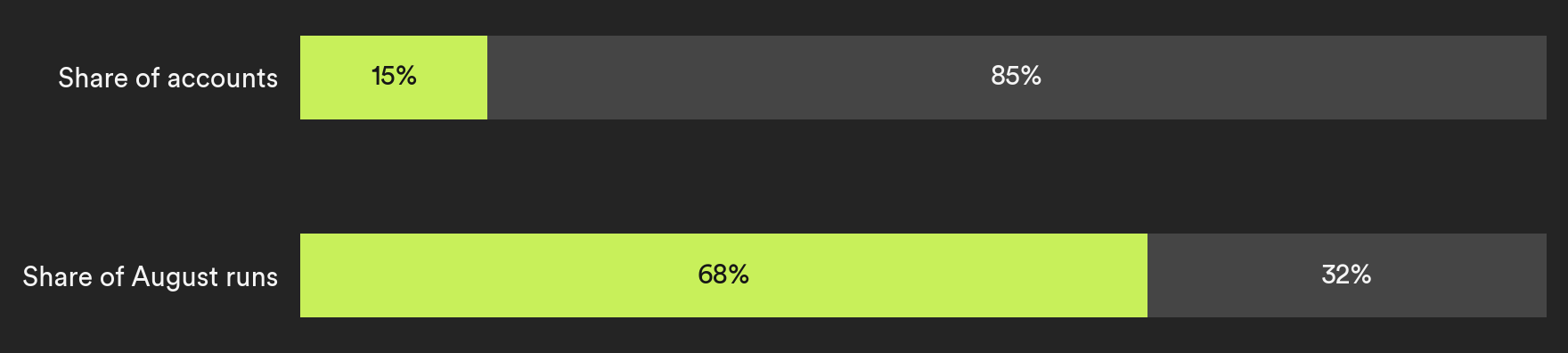
The top 15% of accounts generate 68% of workflow runs, while most accounts show limited repeat usage.
Business implication
Usage growth may be coming from a small group of power users, not broad customer adoption.
Recommended action
Make a repeat run within seven days the activation milestone. Update onboarding and customer-success triggers to help more new accounts reach it.
Validate
Run a targeted onboarding test. Scale it only if it increases seven-day repeat use and those accounts show stronger 30-day retention, expansion, or contribution margin.
What Relay does
Relay AI connects the business systems a team already uses to automate repetitive work.
Example: when a new lead arrives, Relay adds it to the CRM and alerts the right sales owner.
Usage grew 42%. Only 35% of accounts run a workflow again within seven days.
Run an A/B test for the inbound-lead handoff workflow. Assign new accounts to either the current onboarding or a version that walks them through connecting their CRM and running the workflow again within seven days. Measure the effect on seven-day repeat use, day-30 activity, and contribution margin.
Key metrics
42%more workflow runs in August vs. July
35%repeat within seven days 1,680 of 4,800 accounts
52.5%contribution margin August, before overhead
01
Usage is concentrated.
720 accounts generate 68% of August runs. Only 1,680 of 4,800 accounts completed a second run within seven days. The growth is not yet broad across the account base.
02
Connection is the first thing to test.
59% of accounts with a live connection before their first run run the workflow again within seven days, compared with 22% of accounts without a connection. That does not prove connection causes repeat use; it gives the team a specific onboarding change to test.
03
Not all volume is equally valuable.
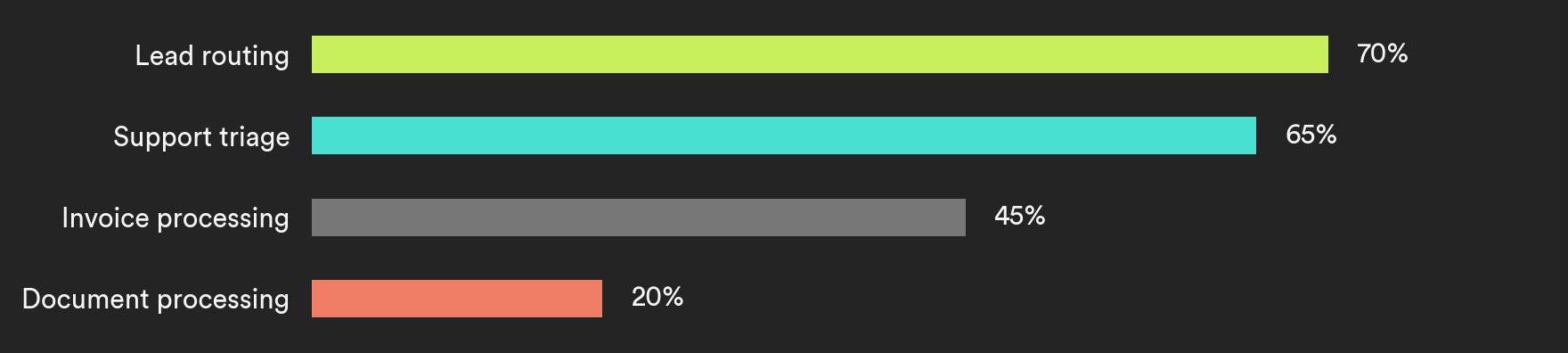
Lead-routing accounts deliver 70% contribution margin; document-processing accounts deliver 20%. More runs only help the business when the workflow can support them economically.
Next step
Run the A/B test for inbound-lead handoff onboarding. Keep the new flow only if it improves seven-day repeat use, day-30 activity, and contribution margin.
Relay AI / Key signals
Key signals
90% complete a first workflow. 35% run it again within seven days.
The data points to one onboarding problem: first use is not reliably becoming repeat use.
01
First use is common. Repeat use is not.
35%
90% of accounts complete a first workflow, but only 35% run it again within seven days. The adoption gap begins after the first successful run.
02
A connected system changes the picture.
36.8pp
Accounts connected before their first run have a 59% repeat rate, versus 22% for accounts without a connection: a 36.8-point gap. Account readiness may explain part of the difference.
03
Not all workflow volume is equally valuable.
70%CM
Lead routing: 23% of runs, 30% of revenue, 40% of contribution, 70% margin.Document processing: 34% of runs, 20% of revenue, 8% of contribution, 20% margin.
Data analyzed
Signups and first workflow data
First run and seven-day repeat use
CRM connection before first run
Day-30 activity, monthly runs, revenue, variable cost, and contribution margin
Relay AI / Adoption quality
Adoption quality
The drop-off comes after the first run.
Workflow runs grew from 2,400,000 to 3,408,000. But only 35% of new accounts ran a workflow again within seven days of their first successful run.
From trial to repeat use
4,800 new accounts
New accounts
4,800
First successful run
4,320
Repeat within 7 days
1,680
2,640 of 4,320 first-run accounts do not repeat in the seven-day window. A later repeat can still occur.
720 accounts drive most of the volume
August 2026
Top 720 accounts Other 4,080 accounts
Adoption by signup cohort
Every account observed for 30 days
Activation and product retention by cohort
Cohort
Accounts
First run
7-day repeat
Day-30 active
Repeat: a successful run of the same workflow on a different day, within seven days of the first. Day-30 active: a successful run during days 24-30 after signup. Rates use all accounts in each cohort. Monthly concentration and onboarding rates measure different behaviors.
Action
Define activation as a second workflow run within seven days. Then compare activation rates across workflow types and signup cohorts to identify where new accounts are most likely to come back.
Relay AI / Repeat-use model
Repeat-use predictor model
We tested four early signals of repeat use. CRM connection was the strongest.
Logistic regression on 4,320 accounts that completed a first workflow. We tested connection, time to first use, templates, and teammate invitation, while accounting for first workflow and signup cohort.
Which early behaviors are associated with a second run?
Longer bars show a stronger link to a second run. Each number is our best estimate; its 95% range shows the plausible size of that link given the data. The teammate result is inconclusive because its range includes zero.
What this tells us
Connection has the largest estimated association with repeat use. Template use and fast first use also show positive links; the model does not establish what caused any of them. Connection is the clearest onboarding change to test.
Decision
Prioritize connection-first onboarding. Randomize it against the current flow on page 8, then keep it only if the repeat-use lift holds without a material increase in support or variable cost.
Relay AI / Economic sustainability
Economic sustainability
The value of repeat use depends on the workflow.
August contribution is $422,590 on $804,480 revenue. The 52.5% blended margin hides a 50-point spread across workflow groups.
Contribution margin by account's primary workflow
August 2026
Monthly revenue and allocated variable costs by workflow group
Account group
Revenue
Variable cost
Contribution
Total
$804,480
$381,890
$422,590
Contribution = revenue less model/API, execution, and variable support costs. Excludes fixed payroll, acquisition costs, and overhead; it is not net profit.
Decision
Pilot where unit economics are strongest. More retained activity only pays if incremental contribution exceeds onboarding and support costs.
Relay AI / Onboarding test
Onboarding test
Does earlier CRM connection increase repeat use?
Run an A/B test with new accounts that select inbound-lead handoff as their starting workflow.
Test scope
Question
Does guided CRM connection plus a saved workflow increase seven-day repeat use?
Eligible accounts
New accounts that select inbound-lead handoff before being assigned to a test group.
A: Current flow
Existing onboarding.
B: Test flow
CRM setup guide, saved workflow, and a day-three reminder when there is no second run.
Success measure
Percentage of assigned accounts in each group that rerun their first workflow within seven days of their first successful run.
Secondary checks
Day-30 activity, contribution per assigned account, run failures, and support burden.
Adopt if
Repeat use rises by at least 10 points without worse contribution per account; verify paid retention before full rollout.
Timing
Enroll roughly 390 eligible accounts per group, then follow every enrolled account for 30 days.
Extrapolated first-year contribution increase after rollout
$71k-$142k
At 425 eligible new accounts a month, a 10-point repeat-use lift would add about 43 repeaters monthly. The range assumes 25-50% of them stay paying for six extra months at today's lead-routing margin. This is an extrapolation, not a measured return; added onboarding and support costs are excluded.
Relay AI / Conclusion
Conclusion
Test guided CRM connection. Scale only if the economics improve.
Only 35% of accounts run a workflow again within seven days. CRM connection is the strongest early signal in the model, but that does not show it causes repeat use.
Decision
Run the inbound-lead handoff A/B test. Require a 10-point repeat-use lift, then confirm paid retention and contribution per account before full rollout.
Extrapolated first-year contribution increase
$71k-$142k
Conditional on the repeat lift and six extra paid months for 25-50% of additional repeaters. Before added onboarding and support costs; not a forecast.